Wedding Celebrant in Berlin & Brandenburg
So every guest feels part of your ceremony.
Wedding ceremonies entirely in English or entirely in French, as well as bilingual ceremonies in German and English or German and French, in Berlin and Brandenburg. If you've been searching for an English speaking wedding celebrant in Berlin, you're in the right place. Every family understands. Every guest belongs.
Request your date
Half your guests speak German. The other half don't.
You know the scene: a beautiful ceremony, moving words — and one side of the family smiling politely, waiting for someone to whisper a summary. Your grandmother from Brandenburg. Your best friend from Manchester. Your aunt from Lyon.
A wedding where half the guests are just politely waiting is only half a wedding.
Every guest deserves to laugh at the same moment.
I believe a ceremony isn't something guests attend. It's something they belong to. From the first word to the last — nobody sits outside the story. That's not a service feature. That's how I work, in every language.
I create bilingual ceremonies — German–English or German–French.
Not translated sentence by sentence. Nobody survives hearing every line twice, and no joke does either. Instead, I weave both languages together: your story moves between them, the key moments happen in both, and each family gets passages that are truly theirs — not a summary of what the others just heard.
I conduct bilingual ceremonies in German and English or German and French. One celebrant, one voice, both languages — every word carefully prepared. Your German family and your English (or French) family experience the same ceremony, not two versions of it.
Prepared, not improvised. Every bilingual ceremony is written, refined and rehearsed beforehand — every phrase, every pause, every punchline in both languages. I don't improvise translations on your wedding day. That's not caution; that's craft. The moments that move people are the ones someone cared about in advance.
German and French, woven with the same care.
Some couples bring together Germany and France. Others bring together two families that have lived in both countries for generations. Whatever your story looks like, a bilingual German–French ceremony means nobody has to rely on whispered translations — both families experience the ceremony together.
If you would like your whole ceremony to be in French, I offer that too. We choose the format together, based on your wishes and the languages your guests understand.
Pour les familles francophones
Je célèbre votre cérémonie entièrement en français ou en version bilingue français-allemand. Votre histoire et les langues de vos proches guident notre choix.
Toutes les informations en français →Entirely in English. Or entirely in French.
Yes, I write and lead complete wedding ceremonies in English or French. If your guests speak different languages, you can choose a bilingual ceremony in German and English or German and French. All four formats cost €1,700 including VAT. We talk through the language choices together, so the ceremony fits you and your guests.
From first call to final word.
We meet, online or in person
A free, unhurried conversation. You talk, I listen. (Listening is the part of this job I trained thirty years for, in two careers before this one.)
I gather your story, from both sides
We meet in person for an in-depth preparation conversation, usually lasting two to three hours. We agree how to communicate comfortably during the preparation. Family members can send me their memories in German, English or French.
I write and weave
A personal ceremony script in your chosen language or languages, with room for humour and the moments that matter. You'll know the structure; the words stay a surprise.
Your ceremony
Usually 30 to 60 minutes, depending on music, contributions, rituals and your own vows.
One ceremony, two languages, zero spectators.
The moment I work towards
Imagine your grandfather smiling because he finally understands why everyone else is laughing.
Imagine your partner's mother hearing your vows in her own language.
That's the moment. Everything else — the script, the structure, the two languages woven into one — exists so that it can happen.
Couples whose love didn't check the language first.
Most couples who find me are German–English or German–French — one of you grew up here, the other in Manchester, Melbourne, Lyon or Montreal. Some are international families who have carried two languages through generations. Others live abroad and are planning a destination wedding in Berlin or Brandenburg, with guests flying in from everywhere.
What they share: rows of chairs where two languages will sit side by side — and the wish that nobody in those rows is merely a spectator.
After the ceremony, in their words.
The ceremony was exactly what we had wished for. Told in images, humorous and emotional. Our guests and we had a fantastic day, and with you it began perfectly and so beautifully in tune with us.
Thank you for the wonderful, personal and heartfelt wedding speech. Many guests came up to us afterwards, completely delighted. Thank you for guiding us and our guests through the ceremony so warmly.
An absolutely exceptional celebrant. Kati created our ceremony with a presence, warmth and clarity that moved us deeply. With every sentence you can tell this isn't simply her job, it's her calling. Her words were authentic, precise and free of anything put-on. We felt seen and carried in every single moment.
The way she told our story was loving, light and exactly to the point. She made our day something truly special. We recommend Kati with all our hearts, to anyone looking for a ceremony that is genuine, personal and completely right. Thank you for everything, Kati.
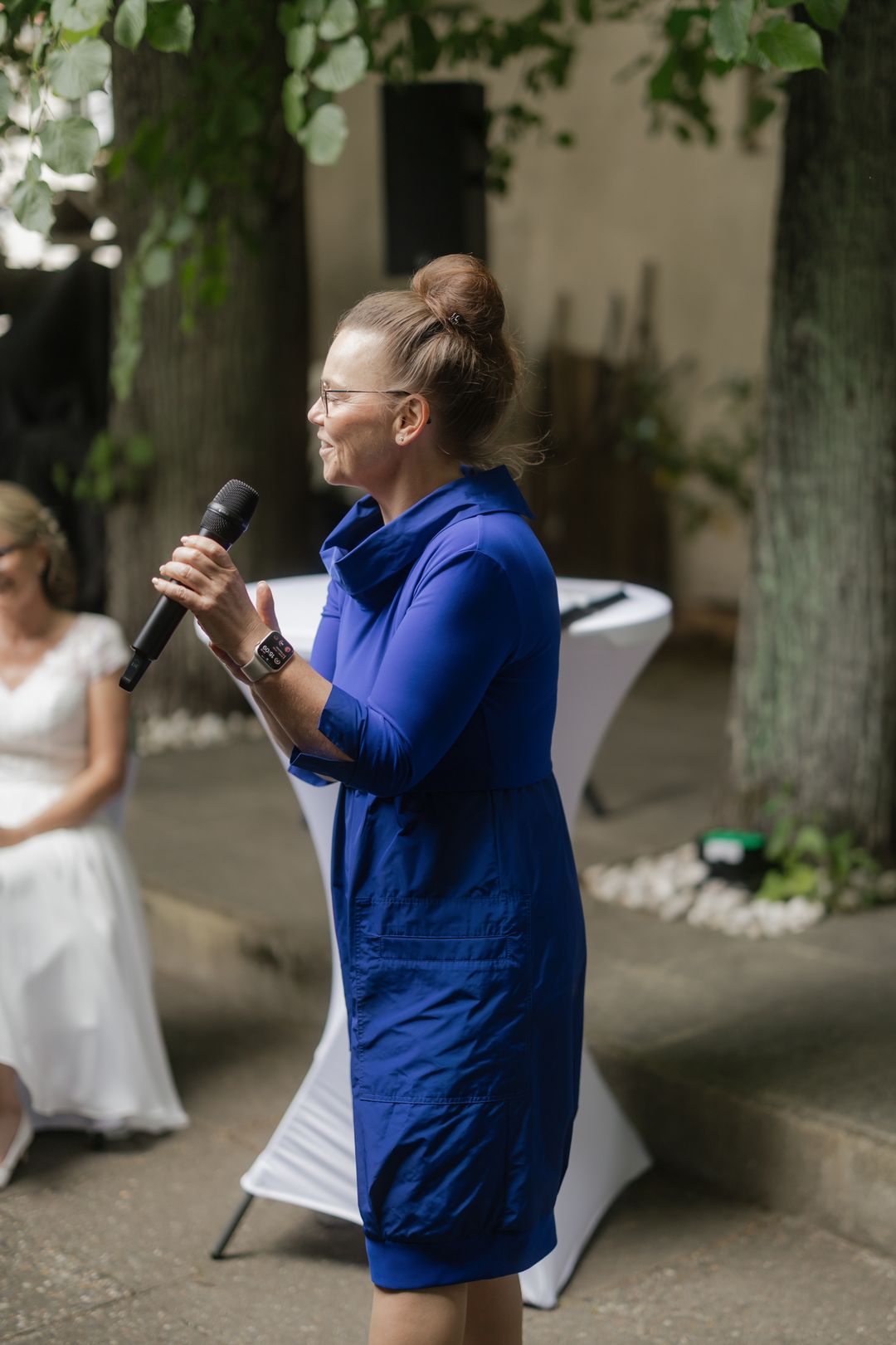
In the moment
Every guest included, in the language that reaches them. This is what it looks like when the whole room leans in.
Questions international couples ask me
Do you perform English-only ceremonies?
Will everything be said twice?
Can you officiate in German and French?
What's the difference between a wedding celebrant and a wedding officiant?
Our guests speak three languages. What then?
Can family members speak in their own language?
Where do you officiate?
What does a bilingual ceremony cost?
Is a free ceremony legally binding in Germany?
Do you also officiate vow renewals in English or French?
How far in advance should we book?
One price, one promise.
Your partner prefers reading in German?
Send them this page — it covers the same ground in their language, from how a woven ceremony works to what it costs.
Trauung auf Deutsch und Englisch →
Let's find out if we fit.
A first conversation costs nothing and commits you to nothing — except 30 minutes with someone who will ask better questions than "What's your colour scheme?"
More for planning your ceremony.
Freie Trauung
The main page. How I work and why your ceremony belongs to no one but you. In German.
Read more →Freie Trauung Berlin
Getting married in the city itself. Venues, vibe and how I work in Berlin. In German.
Read more →Pricing in detail
Every price explained transparently, including the bilingual ceremony. In German.
Read more →Elopement Wedding Berlin
Getting married just the two of you, in Berlin and Brandenburg. In German.
Read more →Rituals for your ceremony
From the sand ceremony to ring warming. Ideas and meaning. In German.
Read more →